Silver and jewellery on Portobello Road: a buyer’s guide
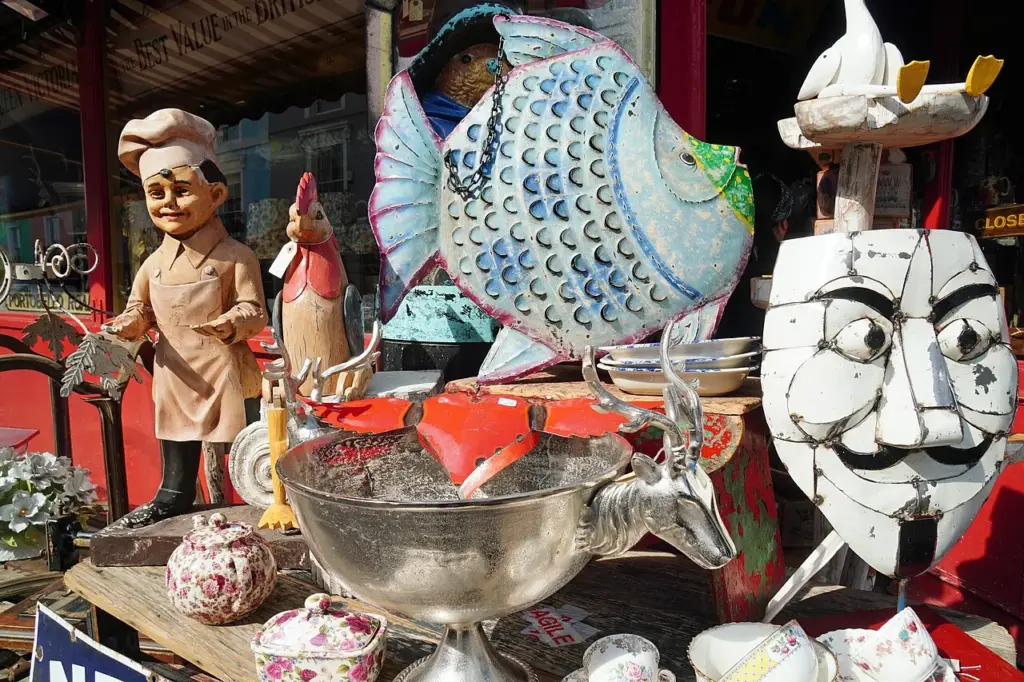
Saturday mornings, the southern end and a loupe-level look at the marks. How to buy silver and jewellery on Portobello Road: fineness numbers, date letters, the pre-1950 rule and what dealers must show you.
For silver and jewellery on Portobello Road, go on a Saturday morning, stay at the southern end, and read the fineness number before the price tag. A UK hallmark guarantees the precious metal content of a piece, so learn the handful of numbers that matter: 925 for sterling, 375 for 9 carat gold, 950 for most platinum. And know the one rule that matters most at an antiques market: an unmarked piece made before 1950 can be sold as silver or gold, but only if the seller can prove its age and purity.
This page is the specialist follow-up to our general guide to buying antiques on Portobello Road, which explains the three parts of a hallmark, the Dealer’s Notice and how to haggle. Here we focus on what’s specific to silver, gold and jewellery.
Silver and jewellery at a glance
- WhenSaturday, when the indoor arcades trade
- WhereThe southern antiques end, around Chepstow Villas and Westbourne Grove
- Sterling silver925 parts per thousand; the lion passant is optional
- 9 carat gold375, the UK’s lowest gold standard
- Unmarked and old?Sellable as precious metal only with proof it predates 1950 and meets the minimum standard
Where to find silver and jewellery on Portobello Road
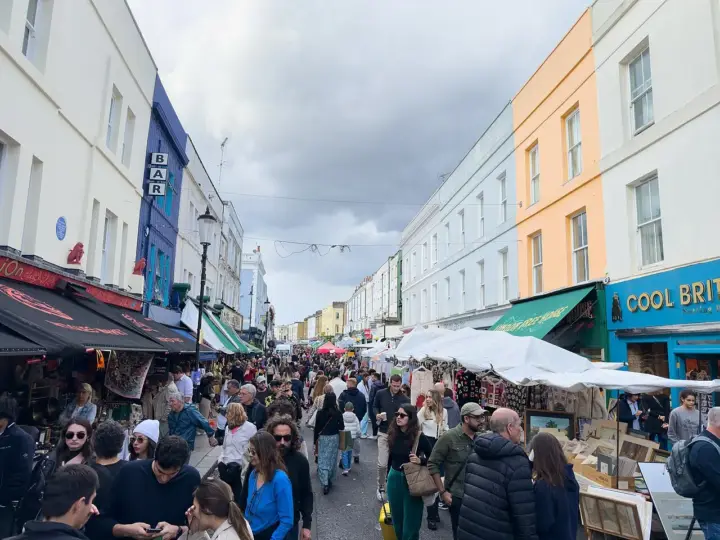
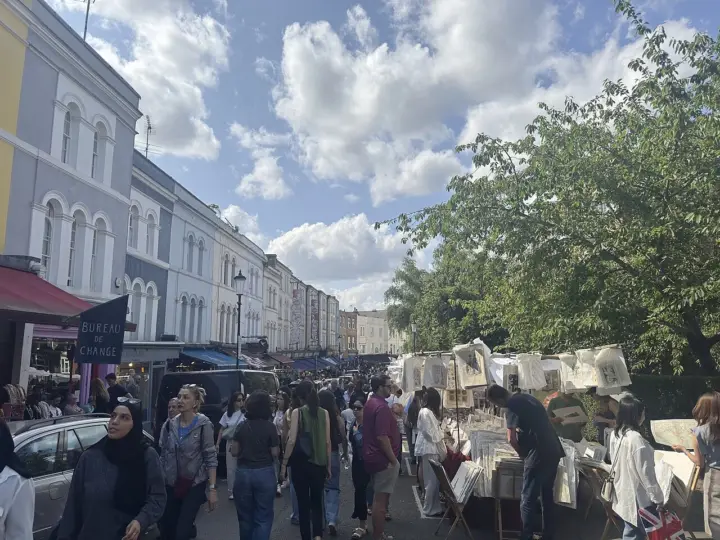
Silver lives at the antiques end. Visit Portobello puts the Saturday arcades between Chepstow Villas and Westbourne Grove, opening early and closing at about 4pm, with more antique stalls along Westbourne Grove on the same day. Silver dealing on this stretch goes back a long way: the Ladbroke Association’s account of the road records “A. Pash, the antique silver dealer” at No. 135.
OpenStreetMap lists several shops nearby whose names suggest silver, jewellery or watches. Silver Fox Gallery (121 Portobello Road) and The Crown Jewels (119) are tagged as antiques shops, Atlam Pocket Watches is at 111, and Almas Jewels, tagged as a jeweller, is at 137. Further up, Energy To Seek at 231 is also tagged as a jeweller. We haven’t checked what any of them stock, so confirm before making a special trip. For how the indoor markets work, read our guide to Portobello Road’s antiques arcades.
New jewellery stalls are another matter. Kensington and Chelsea council says jewellery is one of the trades it isn’t currently registering new stalls for, so the jewellery pitches you see belong to traders already on its books. How that system works is covered in how you become a trader on Portobello Road.
Fineness numbers: what 925, 375 and 950 mean
Of the three compulsory marks, the fineness mark is the one to find first at a stall. It’s a number giving the precious metal content in parts per thousand. Older British pieces usually add a traditional symbol beside it, which the Sheffield Assay Office says is now optional.
| Metal | Number to look for | Traditional symbol (optional) |
|---|---|---|
| Sterling silver | 925 | Lion passant |
| Britannia silver | 958 | Britannia figure |
| Silver, legal minimum | 800 | None |
| 9 carat gold (the minimum) | 375 | Crown, for gold |
| Platinum | 950 | Orb |
| Platinum, legal minimum | 850 | None |
Sources: GOV.UK hallmarking guidance; Sheffield Assay Office; the Edinburgh Assay Office’s pre-1950 guidance notes, published on GOV.UK.
The assay office mark tells you where the piece was tested. London’s is the leopard’s head, and the four UK offices still operating are in London, Birmingham, Sheffield and Edinburgh.
Date letters
A date letter can narrow a piece down to a single year. Since 1975, Sheffield explains, all four offices have shared one letter, which changes every 1 January, and the present alphabet lasts until 2028. Earlier pieces are trickier, because each office ran its own sequence, so you need that office’s tables. Modern pieces may have no letter at all, since it became optional in 1999.
Can’t place a mark? Send clear photographs to the Goldsmiths’ Company’s Library, which identifies pre-1975 marks from images but not from written descriptions. The London Assay Office helps with post-1975 London marks from a photo.
Seven centuries of hallmarks
When each mark arrived matters. A piece whose marks are younger than the age claimed for it needs explaining. These dates come from the London Assay Office’s own history.
- 1300 A statute of Edward I requires silver to be sterling standard, and work to be marked with the leopard’s head.
- 1363 An ordinance of Edward III establishes the maker’s mark.
- 1478 London introduces the date letter.
- 1544 The lion passant joins the hallmark.
- 1697 The higher Britannia standard arrives, with a seated Britannia replacing the leopard’s head and lion passant.
- 1757 Counterfeiting hallmarks becomes a felony punishable by death.
- 1975 The Hallmarking Act 1973 takes effect on 2 January, bringing in platinum marks; on 1 April the UK ratifies the International Convention on Hallmarking.
- 1999 Date letters stop being compulsory.
Unmarked silver and gold: the pre-1950 rule
Plenty of genuine old silver and jewellery carries no full hallmark. That isn’t automatically a problem, but it changes what a dealer can legally call it.
- Light pieces. Below 7.78 grams of silver, 1 gram of gold or palladium, or 0.5 grams of platinum, no hallmark is needed. Only the metal counts towards that weight, not any stones.
- Made before 1950. The assay offices’ guidance notes on pre-1950 articles allow an older unmarked item to be sold as precious metal where the seller can show it was made before 1950 and reaches the minimum standard: 800 for silver, 375 for gold. It also mustn’t have been improperly altered since 1950.
- Earlier exemptions. Before 1975, Sheffield says, some items were exempt, including certain rings (though not wedding rings), lockets and filigree work. Platinum wasn’t hallmarked before 1975, and palladium not before 2010.
- Foreign marks. A convention mark from a member country is legally recognised in the UK without a British hallmark, GOV.UK says.
So when an unmarked teapot is labelled “Georgian silver”, the fair question is simply: how do you know? The law expects the seller to prove it. You don’t have to disprove it.
Good to know: a row of tiny pictures stamped on a piece isn’t the same as a hallmark, because plated wares often carry look-alike marks. Our guide to spotting reproductions at antiques markets covers the warning signs, and RBKC’s rules ban its traders from applying marks that could be mistaken for one.
Jewellery: stones, repairs and plating
A hallmark only vouches for the metal. It says nothing about the stones, whether a clasp has been replaced, or whether a ring has been resized. Those are matters for the dealer’s description, so ask about each one and have the answers written on your receipt.
Plating is the other trap. The council’s guidance for its traders is that a description must not suggest precious metal just because of a piece’s colour or surface. Its own model wording, “gold plated brass cufflinks”, shows how plainly a plated piece should be labelled. If something looks gold but the label avoids the word “gold”, ask what the metal is.
A silver buyer’s checklist
- Bring a magnifier Marks on rings and small silver are tiny. A jeweller’s loupe or your phone’s zoom makes them readable.
- Find the number Look for the fineness mark and the assay office mark, then any date letter.
- Check it against the label “Sterling” should read 925 or show a lion passant, and “9 carat” should read 375. If they disagree, ask why.
- Question anything unmarked Ask when it was made, what it’s made of, and what evidence the dealer has.
- Treat stones separately Get the dealer’s description of any stones in writing.
- Keep the paperwork A receipt naming the metal, rough date and any repairs, plus the dealer’s details.
Saturday is the day for all of this. Our hour-by-hour Saturday on Portobello Road gets you to the arcades early, the antiques directory lists every dealer we’ve mapped, and our Portobello Road Market guide covers the rest of the road. Comparing other markets? See London’s best antiques markets.
FAQs
What does 925 mean on silver?
Sterling silver: 925 parts per thousand of pure silver. British pieces often add a lion passant beside it, though that symbol is now optional.
Can a dealer sell unhallmarked silver as silver?
Only if it’s under 7.78 grams, carries a recognised convention mark, or dates from before 1950 and the seller can prove both its age and that it’s at least 800 fine.
Which day is best for silver on Portobello Road?
Saturday, because that’s the only day the indoor antiques arcades at the southern end trade.
Does a hallmark cover the stones in a ring?
No. It covers the metal only, so ask the dealer to describe any stones on the receipt.
Who can identify an old hallmark for me?
The Goldsmiths’ Company’s Library works from clear photos of pre-1975 marks, and the London Assay Office helps with post-1975 London marks.
Sources
- Hallmarking is the law: guidance summary, GOV.UK, gov.uk
- Mixed metals and pre-1950 articles guidance notes, GOV.UK (published 12 July 2013), gov.uk
- Hallmarking: how businesses can comply with the law, GOV.UK (updated 9 December 2021), gov.uk
- UK Hallmarks, Sheffield Assay Office, assayoffice.co.uk
- Is your pre-loved jewellery breaking the rules?, Sheffield Assay Office, 7 August 2020, assayoffice.co.uk
- History of hallmarking, The Assay Office London, assayofficelondon.co.uk
- How to trace a hallmark, The Goldsmiths' Company, thegoldsmiths.co.uk
- Guidance for selling precious metal items to the public, RBKC (updated 3 September 2024), rbkc.gov.uk
- Markets and street trading, RBKC (last updated 14 October 2026), rbkc.gov.uk
- Where? (antiques arcades), Visit Portobello, visitportobello.com
- Portobello Road, Ladbroke Association, ladbrokeassociation.org
- Places around Portobello Road Market, OpenStreetMap contributors (ODbL), fetched 22 November 2026, openstreetmap.org
Main photo: David, CC BY 2.0, via Wikimedia Commons.