From farm lane to world-famous market: a history of Portobello Road
Portobello Road began as a farm track named after a 1739 naval victory, grew a food market in the 1860s and became an antiques centre after the Second World War. Here's how it happened, date by date.
Portobello Road started life as a farm track. It takes its name from Portobello Farm, named in honour of Admiral Vernon’s capture of Puerto Bello, in present-day Panama, in 1739. A street market grew up in the 1860s, as Victorian builders covered the fields with houses, and it was established by 1870. For decades it was mostly a food market. Then, after the Second World War, the antiques dealers arrived, and in 1951 the first antiques arcade opened. Most of what visitors come for today dates from that post-war turn. Here is the history of Portobello Road Market, from the farm to the stalls you’ll find in our Portobello Road Market guide.
A lane through farmland
In the 18th century this was open country. The London Museum describes Portobello Road as a country lane where farmers sold their produce. The Survey of London, the standard architectural history of the capital, records that access to Portobello Farm “was by way of Portobello Lane (now Road)”, and that the farmhouse stood on the east side of the lane, on a site later occupied by St Joseph’s Home.
The name is a souvenir of empire. In 1739, during the War of Jenkins’ Ear, a British fleet under Admiral Vernon captured Puerto Bello. The farm “so named in honour” of that victory, as the Survey of London puts it, passed its name to the lane. The admiral himself is remembered further down the road, in the name of an antiques arcade.
Locals called the road “The Lane” well into the 20th century, according to the Ladbroke Association, the local amenity society. Some accounts give an older name, Green’s Lane. Wikipedia attributes it to the Survey of London, but the chapter it cites doesn’t contain the name, so we treat it as unconfirmed.
The Victorians build over the fields
In 1755 Charles Henry Talbot bought the farm, then described as 170 acres and “parcel of the Manor of Notting Barns”. His family held it for a century. The Survey of London traces how it was sold off as London spread west: the Misses Talbot tried to sell the whole farm in 1852; seven acres either side of Westbourne Park Road went in 1860; two acres went to Franciscan nuns for a convent in 1862; most of the rest was sold in 1862–63; and the last 41 acres went in 1868.
Building had already begun at the southern end. The Ladbroke Association says construction started in the late 1840s and moved from south to north. Pubs came first, as they often did. The Earl of Lonsdale dates from about 1847 and the Warwick Castle (now The Castle) from about 1853. In 1864 the Hammersmith & City Railway was completed and Ladbroke Grove station opened, the London Museum notes, bringing a new population within reach.
When did the market start?
Nobody can give an exact date, and the sources say so in different ways:
| Source | What it says |
|---|---|
| Survey of London | “A street market in Portobello Road growing up” with the 1860s building boom; no date |
| RBKC, which runs the market | “From the 1860s Portobello and Golborne Road have developed into these iconic markets” |
| Ladbroke Association | A fresh-food market formed quickly, “possibly as early as the 1860s” |
| London Museum | “Probably established by 1870” |
| Wikipedia | c.1863, citing an 1893 London County Council report we haven't seen |
The safest wording is that the market dates from the 1860s and was established by 1870. That also explains why age claims vary: the council’s Markets Plan speaks of a “150-year history”, while RBKC’s markets page and the official market site say 160 years.
For its first half-century it was a food market for the people who lived in the new streets, and it traded only on Saturdays. The Ladbroke Association says it extended to other weekdays in the 1920s, with Thursday kept as an early-closing day. That’s why the Thursday half-day survives today.
Good to know: a 1927 licensing date gets repeated a lot. That year’s London County Council (General Powers) Act did introduce borough licensing for street traders across London, but no primary source we’ve seen ties it to Portobello. These days the council licenses pitches under a 1990 Act; our guide to becoming a Portobello Road trader explains how that works.
The post-war antiques boom
The change that made Portobello famous came after 1945. The Ladbroke Association describes rag-and-bone and bric-a-brac stalls appearing in the 1940s, followed by antique dealers, at first on Saturdays only. The London Museum connects the arrival of antiques to the closure of Islington’s Caledonian Market after the Second World War. RBKC’s Markets Plan credits “the arrival of the antiques traders in the 1950s” with spurring the market on.
We even know some of the pioneers. June Aylward is thought to have been the first antique dealer to take premises on the road, at No. 115, in about 1950. A year later Susan Garth turned Nos. 165–169 into the Red Lion, Portobello’s first arcade, and in the years that followed many of the old shops at the southern end were divided into dealers’ stands. Barham Antiques at No. 83, still listed in our directory, dates from 1962, the Ladbroke Association says.
The trade kept growing through the 1970s and 1980s. By then, the London Museum says, Portobello had become “one of the UK’s largest antiques markets”. Our guide to Portobello Road’s antiques arcades shows which survive today.
New Londoners, new stalls
The market has always changed with its neighbours. The London Museum records Spanish refugees and political exiles settling around Portobello Road and Notting Hill after the Spanish Civil War began in 1936. R. Garcia and Sons, a Spanish delicatessen, began trading in 1957. In the 1950s and 1960s Caribbean families settled in Notting Hill, and the market began selling produce such as yams and green bananas.
That community shaped the area’s best-known event. The London Museum says Portobello Road has hosted the Notting Hill Carnival since 1966. Read more in our guide to Carnival weekend and the market.
The Westway and the modern market
In the 1970s the Westway, a raised stretch of the A40, was built across the northern end of the road. The council’s Markets Plan credits the new flyover with giving the market extra space to grow into. Under its canopy today is Portobello Green Market, a privately run vintage and fashion market. We tell that story in the Westway and the market.
The late 20th century brought money and pressure. The London Museum says the area became affluent from the late 1980s and many long-term independent traders were priced out. As early as 1979, the Ladbroke Association records, a council motion opposed converting shops into antique or clothing outlets aimed at tourists. Then came the film. Notting Hill (1999) was set and partly shot on the road, and RBKC credits it with boosting the market. See the film and the market.
Portobello Road, date by date
- 1739 Admiral Vernon captures Puerto Bello; Portobello Farm is named in honour of the victory.
- 1755 Charles Henry Talbot buys the 170-acre farm.
- Late 1840s House building begins at the southern end and moves north.
- 1852–1868 The Talbot family sells the farm in stages; the last 41 acres go in 1868.
- 1864 The Hammersmith & City Railway is completed and Ladbroke Grove station opens.
- 1860s–1870 A street market grows up; it’s probably established by 1870.
- 1911 The Electric Cinema opens on Portobello Road.
- 1920s The Saturday market extends to other weekdays, with Thursday a half-day.
- 1940s Rag-and-bone and bric-a-brac stalls appear, then antique dealers.
- 1951 The Red Lion Arcade, the first antiques arcade, opens at Nos. 165–169.
- 1966 Portobello Road begins hosting the Notting Hill Carnival.
- 1970s The Westway opens, creating room for the market to expand under it.
- 1993 The Electric becomes the UK’s first Black-owned cinema.
- 1999 Notting Hill is released.
- 2006 The family that owns the Geoffrey Van Arcade sells up, and the arcade shuts.
- 2021 Summer Sunday trading is trialled for the first time (13 June to 22 August); in November the road goes permanently car-free during market hours, after a trial from April 2020.
- 2024 RBKC’s Strengthening Portobello consultation receives 452 responses.
- 2026 RBKC describes the road as “now open on Sundays all Summer”, and runs December Sunday markets.
Portobello today
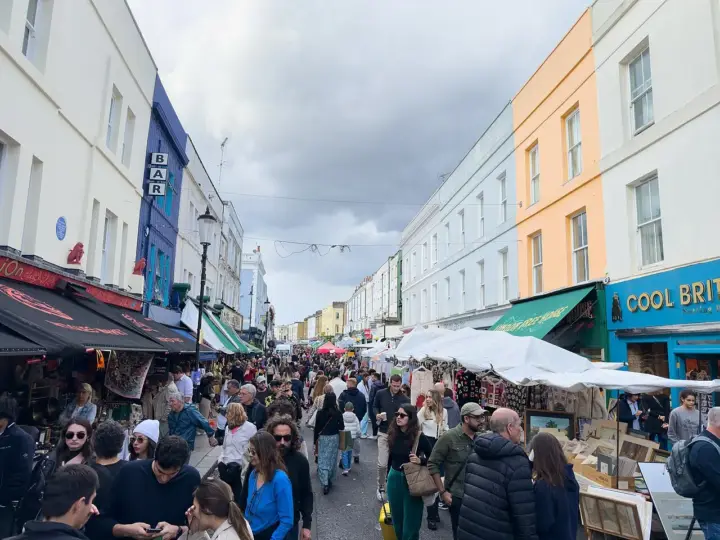
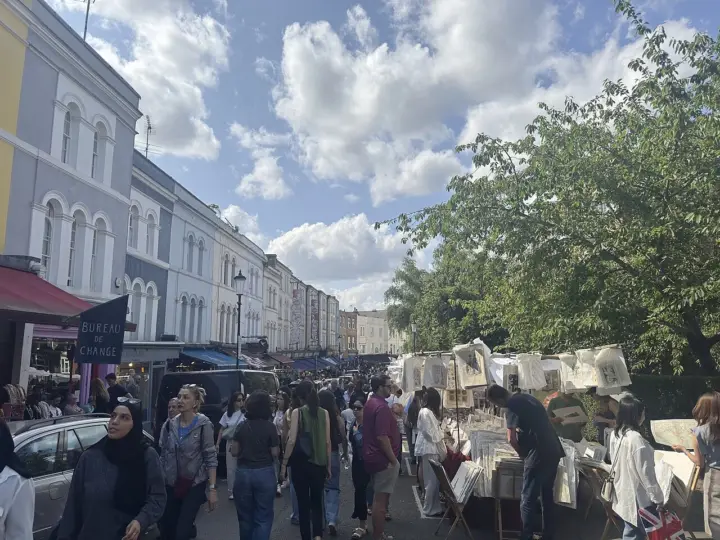
The market now trades Monday to Saturday, with Saturday by far the busiest day. The council’s count is 290 licensed pitches, 240 of them on Portobello Road and 50 on Golborne Road, and that total ignores the shops, the arcades and the privately run markets beneath the flyover. Sunday trading, which RBKC said in 2021 “had not previously been offered”, has become a regular summer and December fixture. And the council’s Strengthening Portobello programme plans an “Antiques Gateway” at the southern end, where the arcades began.
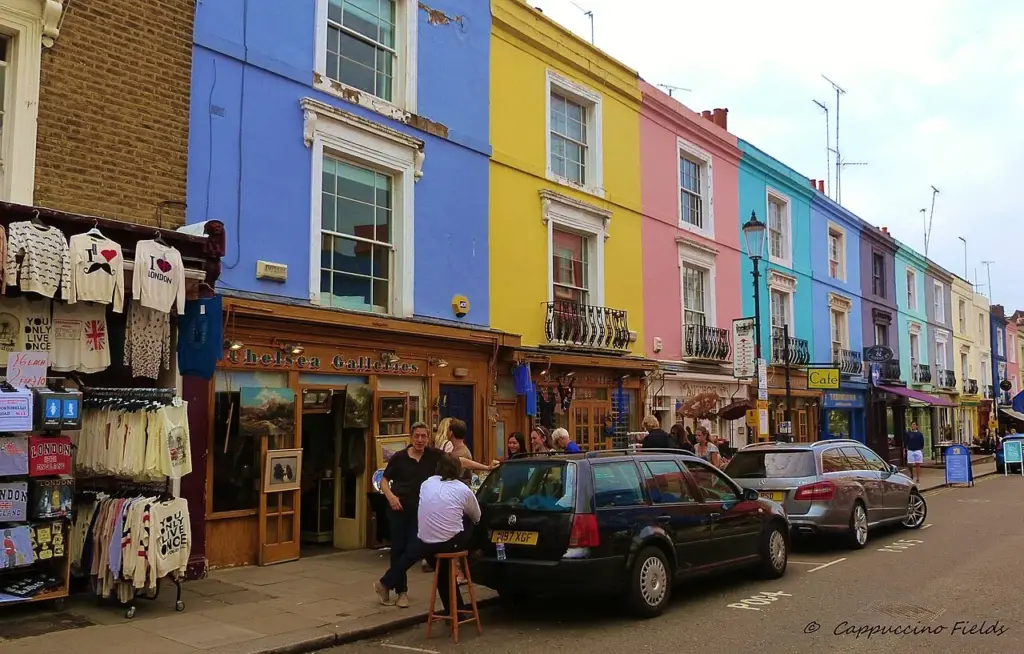
Much of the Victorian road is still there to see. Walk it with our directory of shops and stalls, or read how London’s other street markets began in our history of London’s markets. For a market already trading in the 1500s, see Borough Market’s history in ten dates. For the Survey of London’s full account of the estate, see its chapter on the Portobello and St Quintin estates.
FAQs
Why is it called Portobello Road?
The road was once the lane to Portobello Farm, and the farm took its name from Admiral Vernon’s 1739 victory at Puerto Bello, in what is now Panama.
How old is Portobello Road Market?
Somewhere between 150 and 160 years. Stalls appeared as the streets were built in the 1860s, and the London Museum thinks the market was established by 1870.
When did antiques come to Portobello Road?
After the Second World War. Dealers moved in during the late 1940s and the 1950s, and Susan Garth’s Red Lion Arcade followed in 1951.
Is Portobello the world’s largest antiques market?
That’s often claimed, but we couldn’t find any evidence for it. The London Museum describes it as one of the UK’s largest antiques markets.
Sources
- Survey of London vol. 37, Northern Kensington, ch. XII: The Portobello and St. Quintin Estates (1973), British History Online, british-history.ac.uk
- Portobello Market: London's largest antiques market, London Museum, londonmuseum.org.uk
- Portobello Road, Ladbroke Association, ladbrokeassociation.org
- Markets Plan 2022–27, Royal Borough of Kensington and Chelsea, rbkc.gov.uk
- Markets and street trading, RBKC, rbkc.gov.uk
- Our Story, Portobello Road Market official site, visitportobello.com
- The Red Lion Antiques Market, Visit London, visitlondon.com
- Notting Hill and Portobello Road Market, Visit London, visitlondon.com
- Summer Sundays at Portobello and Golborne market, RBKC newsroom, 11 June 2021, rbkc.gov.uk
- Portobello market goes car-free permanently, RBKC newsroom, 19 November 2021, rbkc.gov.uk
- Strengthening Portobello consultation, RBKC (updated 18 June 2025), consult.rbkc.gov.uk
- Portobello Road, Wikipedia (cited only for the disputed c.1863 date and the 'Green's Lane' name), en.wikipedia.org
Main photo: Justgravy, CC BY-SA 4.0, via Wikimedia Commons.