A walk from Portobello Road through Notting Hill
A self-guided walk from Notting Hill Gate up Portobello Road and through the Ladbroke estate's crescents: a lost racecourse, painted houses, a hilltop church, a former synagogue and the blue door.
The best walk from Portobello Road leaves the market for an hour and climbs west into the Ladbroke estate, the Victorian development of crescents and private gardens that gave Notting Hill its look. Start at Notting Hill Gate, walk up the antiques end of Portobello Road, cut through Elgin Crescent to St John’s Church on the hilltop, loop back along Blenheim Crescent and finish at the Westway and Ladbroke Grove station. On the way you’ll pass the entrance to a lost racecourse, the painted houses, a former synagogue and the film’s blue door. Allow two to three hours with stops.
The walk at a glance
- StartNotting Hill Gate station (Central, Circle and District lines)
- FinishLadbroke Grove station (Circle and Hammersmith & City lines)
- TimeTwo to three hours with stops
- TerrainPavements; a gentle climb to St John’s
- Best daySaturday for the full market; a weekday for quiet streets
- RememberThe communal gardens are private
Why the streets look the way they do
Two hundred years ago this was farmland. The Ladbroke Association, the local amenity society, says the area belonged to James Weller Ladbroke, and that there were only two roads: the Uxbridge Road, now Holland Park Avenue, and “a little lane leading up from Holland Park Avenue called Portobello Lane (now Portobello Road)”, which led to Portobello Farm.
In the 1820s Ladbroke hired the surveyor Thomas Allason to lay out an estate. The Survey of London says Allason’s 1823 plan proposed a broad straight road, now Ladbroke Grove, and a huge circus with private paddocks. The circus was never built. But the idea survived: Allason’s paddocks became the estate’s sixteen communal gardens, and his concentric circles became today’s crescents, among them Elgin, Blenheim, Lansdowne and Stanley Crescents. That’s the shape you’ll walk through.
- 1823 Thomas Allason draws up his plan for the Ladbroke estate.
- 1837 The Hippodrome racecourse holds its first meeting, on 3 June.
- 1860s Developers build the three-storey shops that still line Portobello Road.
- 1900 A church hall at 206–208 Kensington Park Road becomes a synagogue.
- 1910 or 1911 The Electric Cinema opens on Portobello Road (sources differ).
- 1951 The Red Lion Arcade, Portobello Road’s first antiques arcade, opens.
- 1970s The Westway is brought into use across the north end of the road; see how the Westway made room for stalls.
The route, step by step
- Notting Hill Gate to Pembridge Road Leave the station and head north up Pembridge Road. The Prince Albert pub here is one of the area’s earliest, the Ladbroke Association says, and once had a theatre upstairs.
- The racecourse gate Where Pembridge Road meets Kensington Park Road was the main entrance to the Hippodrome, a racecourse laid out across the undeveloped estate in 1837, according to the Survey of London. Nothing of it survives. Look for the cabman’s shelter at the south end of Kensington Park Road.
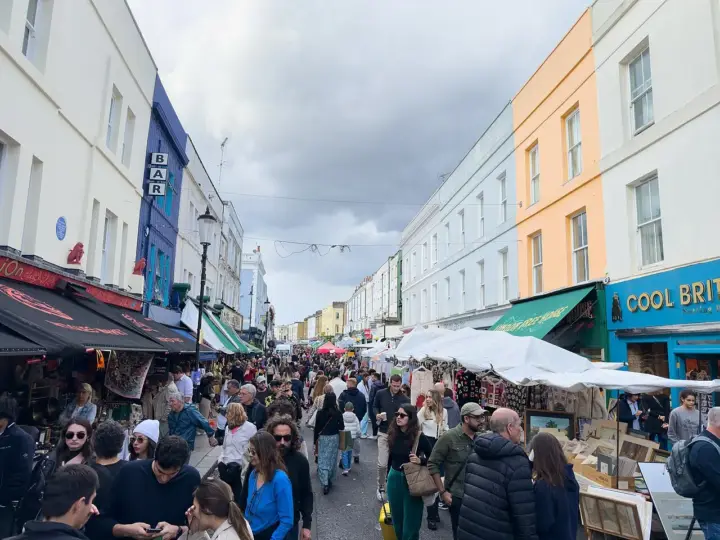
- The antiques end Bear right into Portobello Road. The Ladbroke Association picks out the coloured stucco houses between Chepstow Villas and Westbourne Grove, and on Saturdays the arcades start here.
- Westbourne Grove At the junction, look along Westbourne Grove. The old music hall at No. 291, later the 20th Century Theatre, still has its entrance.
- Into Elgin Crescent Continue north and turn left into Elgin Crescent. Its shops have two floors above, built for the shopkeeper’s family. Further west it’s one of the best streets for painted houses.
- St Peter’s and Kensington Park Gardens Turn left down Kensington Park Road to St Peter’s Church, which the Ladbroke Association calls “probably our most beautiful” and which is usually open. Then walk west along Kensington Park Gardens, with its view towards St John’s.
- The cherry corner At Stanley Crescent and Kensington Park Gardens there’s a group of cherry trees that draws photographers in spring.
- St John’s on the hill Climb to St John’s, “at the high-point of Ladbroke Grove”. The Survey of London says the Hippodrome’s starting and finishing posts stood west of this hill.
- Lansdowne Crescent and Lansdowne Road Look for the pair of villas with little towers in Lansdowne Crescent and the Dutch-style gables and painted houses on Lansdowne Road.
- Back along Blenheim Crescent Return east on Blenheim Crescent. Nos. 43–45 housed a colony of artists, hence the big north-facing windows. Near the Portobello end are Books for Cooks at No. 4 and The Notting Hill Bookshop at No. 13; more in our guide to books and records on Portobello Road.
- The former synagogue Before rejoining Portobello Road, detour a few steps along Kensington Park Road to Nos. 206–208, where the Stars of David can still be seen on the outside.
- North to the Westway Rejoin Portobello Road and head north past the Electric Cinema and The Castle pub at No. 225. Turn into Westbourne Park Road for the blue door at No. 280, then continue to the Westway and Ladbroke Grove station.
The lost racecourse
The Hippodrome is the strangest thing on this walk, because you can’t see it. The Survey of London records that its first meeting was held on 3 June 1837, with the principal entrance at what is now the junction of Kensington Park Road and Pembridge Road. A reconfigured course reopened in 1839 and stretched north-west across the estate. It didn’t last: house-building took over the land, and the hill where the races started and finished is now crowned by St John’s Church.
Painted houses and private gardens
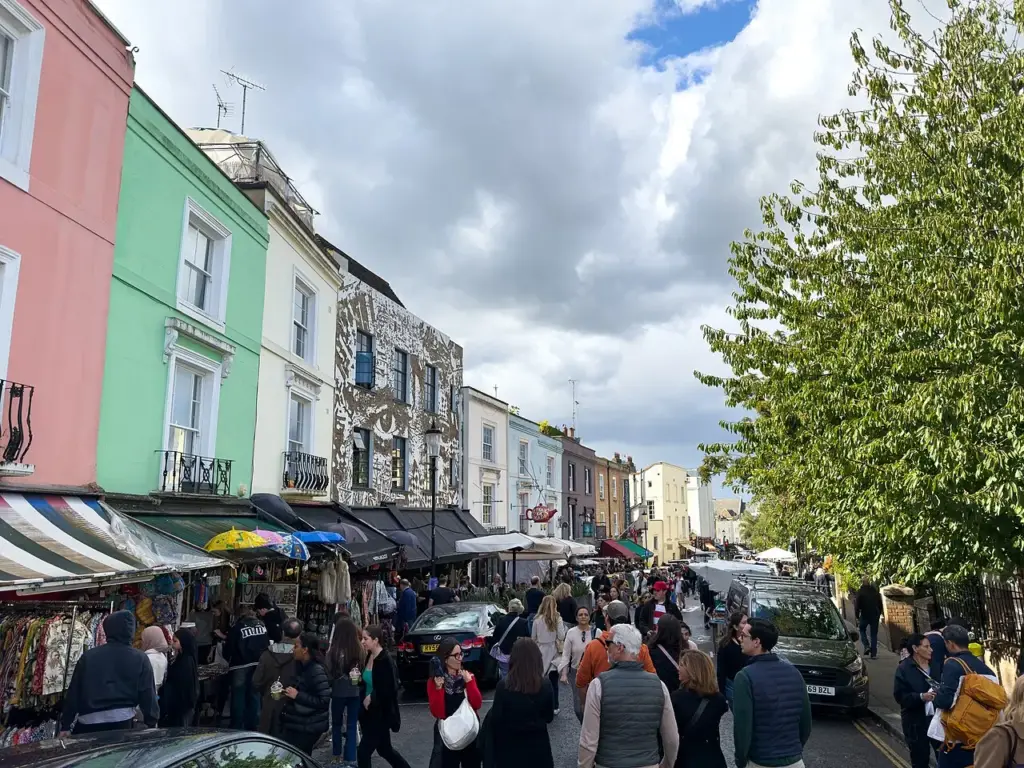
The pastel houses are the most photographed thing in Notting Hill, and they’re newer than they look. The Ladbroke Association says the stucco was painted white once good external paints arrived in the 20th century, and that the fashion for pastel colours dates from about the last 20 years. It names Lansdowne Road and Elgin Crescent as the best streets, plus Portobello Road between Chepstow Villas and Westbourne Grove.
The gardens behind the houses are a different matter. The Ladbroke Association says the sixteen communal gardens “are open only to the residents of the houses bordering them”. You’ll glimpse them through railings and between terraces, which the original developers designed deliberately, leaving gaps so passers-by would see greenery. The film fan’s version is Rosmead Gardens, the private garden in Notting Hill; read about the other locations in our guide to the film and the market.
Be considerate: these are homes. Photograph from the pavement, keep off doorsteps and don’t climb railings. The pavements are narrow in places, so step aside for residents.
Churches, chapels and a synagogue
The estate’s developers wanted churches for their new residents and even helped pay for them, the Ladbroke Association says. Four survive. St John’s and St Peter’s, both Anglican, are the oldest. Kensington Temple, a Pentecostal church, stands where Kensington Park Road meets Ladbroke Road, and the non-denominational Community Church is on Kensington Park Road near Elgin Crescent.
The synagogue tells a different story. At the end of the 19th century, Jewish families fleeing persecution in Russia settled around Portobello Road, many working as tailors. In 1900 they bought the church hall at 206–208 Kensington Park Road. It closed in the 1990s and is now commercial premises.
Pubs, shops and a cinema
The Ladbroke Association counts no fewer than six pubs on Portobello Road between Westbourne Grove and the Westway, a sign of how thirsty market work was. Victorian pubs were usually built on corners, often with a rounded front for signage. Look out for that shape as you walk north. For where to stop, see our guide to pubs on and around Portobello Road.
The shops themselves are history too. The Ladbroke Association says developers built the three-storey buildings with ground-floor shops in the 1860s, and that by the 1950s the southern end was known for antiques. The Electric Cinema is the area’s survivor among picture houses. The London Museum says it opened in 1911; the Ladbroke Association says it “dates from 1910” and is said to be the oldest purpose-built cinema in the country. We’ve given both dates.
Fitting the walk around the market
On a Saturday, do the walk in the middle of the day. Start early with the arcades, set off west from Elgin Crescent around late morning, and come back to the northern market and Portobello Green in the afternoon. On a weekday the market is smaller, but the streets are calm and the walk is the main event. Check our Portobello Road Market guide for what trades each day before you choose, and use our Portobello shops directory to plan coffee stops along the way. The whole route costs nothing, which is why it features in our round-up of free things to do at London’s markets.
Tip: doing it in reverse? Start at Ladbroke Grove station, which is closest to Portobello Green and the Westway, and finish at Notting Hill Gate for the Central line. Our guide to getting to Portobello Road Market covers both stations.
FAQs
How long does a Notting Hill walk from Portobello Road take?
Allow two to three hours for this route with stops for browsing and coffee. Without stops, it’s much shorter.
Can you go into the Notting Hill communal gardens?
No. The Ladbroke Association says they’re open only to residents of the houses that border them. You can see into some through the railings.
Where are the coloured houses in Notting Hill?
The Ladbroke Association names Lansdowne Road and Elgin Crescent as the best, plus Portobello Road between Chepstow Villas and Westbourne Grove.
Was there really a racecourse in Notting Hill?
Yes. The Hippodrome held its first meeting in 1837, with its main entrance at today’s junction of Kensington Park Road and Pembridge Road. It was short-lived, and houses now cover the site.
Sources
- Introduction to the Ladbroke area, Ladbroke Association (2024), ladbrokeassociation.org
- Survey of London vol. 37, Northern Kensington, ch. IX: The Ladbroke estate, the 1820s and 1830s (1973), British History Online, british-history.ac.uk
- Survey of London vol. 37, ch. XII: The Portobello and St. Quintin Estates (1973), British History Online, british-history.ac.uk
- Portobello Road, Ladbroke Association, ladbrokeassociation.org
- Portobello Market: London's largest antiques market, London Museum, londonmuseum.org.uk
- Notting Hill film locations, The Worldwide Guide to Movie Locations, movie-locations.com
- Where?, Visit Portobello, visitportobello.com
- Ladbroke Grove and Notting Hill Gate Underground stations, Transport for London, tfl.gov.uk
- Portobello Road Market places, OpenStreetMap contributors (November 2026), openstreetmap.org
Main photo: Mike Peel, CC BY-SA 4.0, via Wikimedia Commons.

Portobello Road Market
Antiques, vintage & street food · Notting Hill · London W11