Notting Hill (1999) and Portobello Road: the film and the market
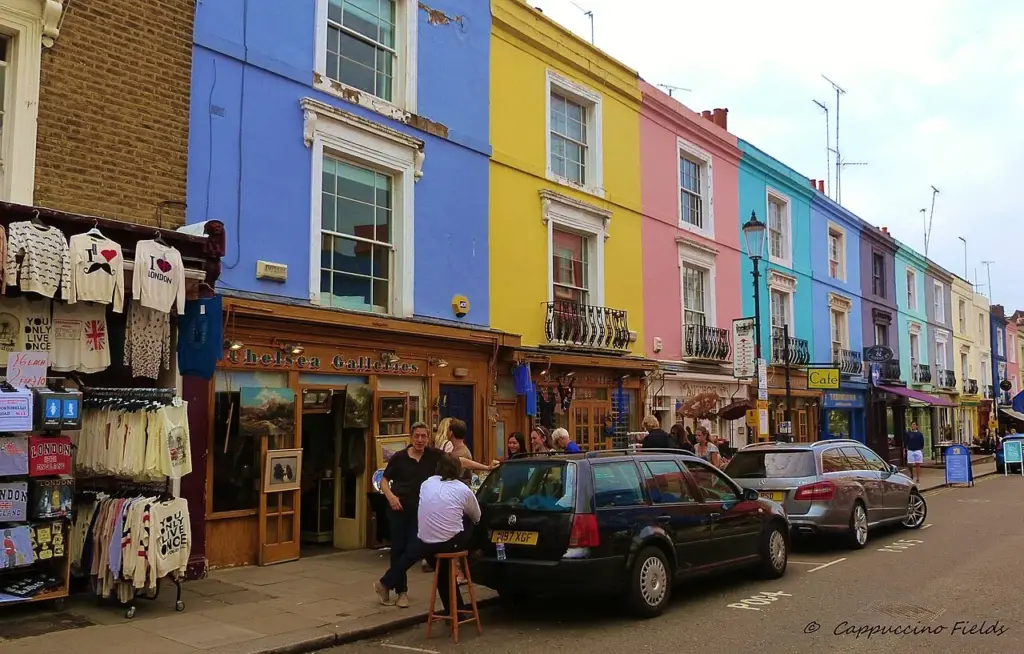
Where Notting Hill was really filmed on and around Portobello Road: the bookshop, the blue door, the collision corner and the market itself, with what stands at each address now.
Yes, Notting Hill really was filmed on Portobello Road. The market scenes were shot on the street itself, the bookshop exterior is at 142 Portobello Road, and the famous blue door is just off it at 280 Westbourne Park Road. The shop that inspired William’s bookshop was a real one too: the Travel Bookshop on Blenheim Crescent, which now trades as The Notting Hill Bookshop. All the main Notting Hill film locations on Portobello Road fit into an hour’s walk, on any day of the week. Below we take them address by address, with what stands there now.
The film at a glance
- FilmNotting Hill, 1999, romantic comedy
- DirectorRoger Michell (BFI)
- WriterRichard Curtis (British Council)
- StarsJulia Roberts, Hugh Grant, Rhys Ifans, Hugh Bonneville, Gina McKee
- Running time2 hours 4 minutes; certificate 15 (BFI)
- Made byNotting Hill Pictures for PolyGram, in association with Working Title (British Council)
- Best day to visit the locationsA weekday morning, when the road is quieter
What the film is, and why it matters to the market
The British Council’s catalogue sums up the plot in a line: William is “the divorced owner of a quiet London bookshop” whose life is simple until “the most famous film star in the World walks into his shop and kisses him”. Hugh Grant plays William; Julia Roberts plays the star, Anna Scott. The BFI calls it a “featherlight, frequently funny romance between an ordinary bloke and a visiting Hollywood starlet”, and singles out Rhys Ifans as Spike, “the flatmate from hell”.
For Portobello Road, the film was more than a backdrop. Visit London says the road “provided the backdrop for a number of scenes”, and the council’s own Markets Plan credits the film with boosting the market’s profile. The Ladbroke Association, the local amenity society, puts it more bluntly: the road that “used to be a market for local residents” is now a major international tourist attraction, “helped by the film”.
The Worldwide Guide to Movie Locations, the most detailed location record we found, says simply: “The market provides the heart of the film.”
Notting Hill film locations, address by address
Here’s where each scene was filmed, and what we found at each address in November 2026. Several are private homes or working shops, so look from the pavement.
| In the film | Where | What’s there now |
|---|---|---|
| William’s bookshop (exterior) | 142 Portobello Road | A souvenir shop; there is no real “Travel Book Company” (movie-locations.com) |
| The shop that inspired it | The Travel Bookshop, 13–15 Blenheim Crescent | Closed in 2011, reopened as The Notting Hill Bookshop at No. 13 (movie-locations.com; listed in OpenStreetMap) |
| William’s flat, the blue door | 280 Westbourne Park Road | A private house (movie-locations.com; Ladbroke Association) |
| The orange juice collision | Corner of Westbourne Park Road and Portobello Road | Later a coffee shop; the café where William buys the drinks, at 303 Westbourne Park Road, has closed |
| Saints Tattoo Parlour | 201 Portobello Road | OpenStreetMap now lists Zoot Vintage at this number |
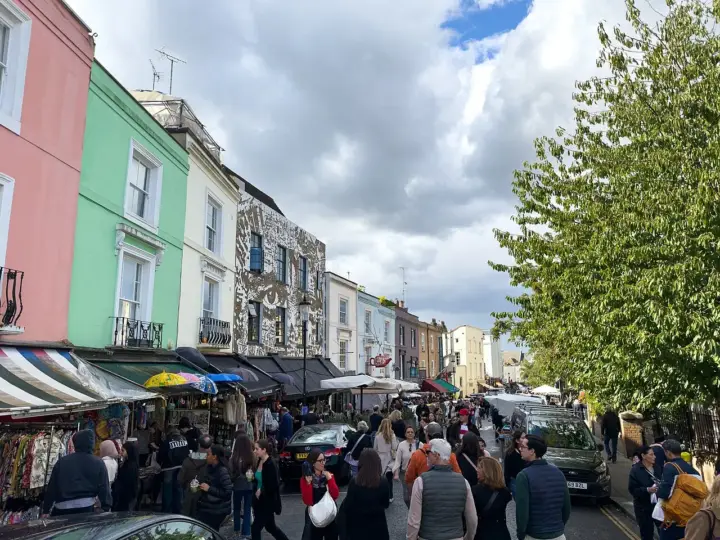
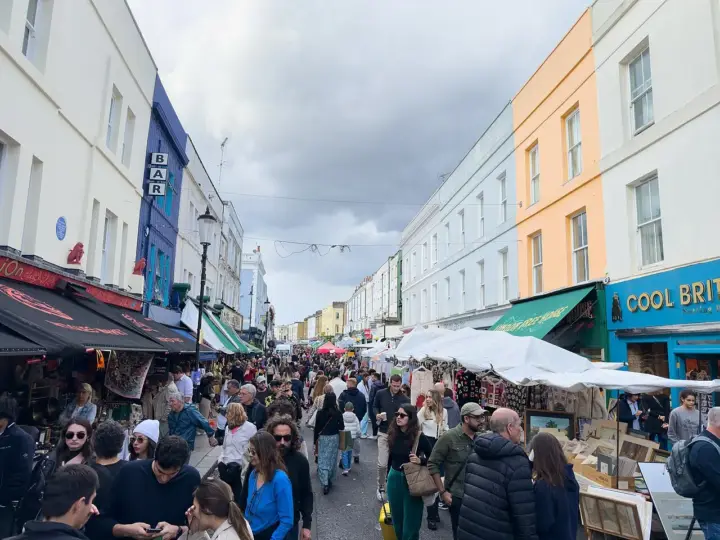
| The market scenes | Portobello Road | The market, Monday to Saturday |
| The cinema | The Coronet, 103 Notting Hill Gate | Now The Coronet Theatre |
| Tony’s restaurant | Golborne Road at Bevington Road | Check before you go |
| The night-time garden | Rosmead Gardens, Rosmead Road | A private communal garden, for residents only |
Good to know: the interiors weren’t all shot on location. Movie-locations.com says the inside of William’s flat was a studio set, and TCM’s film database lists Shepperton Studios among the locations alongside Portobello Road.
The bookshop: 142 Portobello Road and Blenheim Crescent
There are two bookshops to know about, and visitors often mix them up. The shopfront you see in the film is 142 Portobello Road, on the stretch between Elgin Crescent and Westbourne Grove. Today it sells souvenirs, and as movie-locations.com points out, there is no real “Travel Book Company” on the road.
The real inspiration was the Travel Bookshop at 13–15 Blenheim Crescent, a few steps west of Portobello Road. Movie-locations.com records that it closed in 2011 and reopened as The Notting Hill Bookshop at No. 13. It’s still trading and appears in our Portobello shops directory, along with Books for Cooks a few doors along at No. 4 and a café at No. 15b. If you want one location that’s open to the public, this is it, and the round-up of books and records on Portobello Road lists the other bookshops nearby.
Tip: there’s also a gift shop called The Blue Door at 131 Portobello Road, according to OpenStreetMap. It’s a shop name, not the film’s door, which is further north, off Westbourne Park Road.
The blue door: 280 Westbourne Park Road
The door of William’s flat is at 280 Westbourne Park Road, just off Portobello Road. Two sources agree on the address: movie-locations.com and the Ladbroke Association, which notes that “the famous Blue Door is actually just off Portobello Road”. Movie-locations.com adds that the house was the home of the screenwriter, Richard Curtis.
It’s a private house. People do queue for photos, so be quick and keep the steps and pavement clear.
About the door’s sale: you’ll read online that the original door sold at auction for a specific sum. Movie-locations.com says only that the door “was removed and auctioned off for charity”, without a buyer or price. We couldn’t find a primary record of the sale, so we don’t repeat a figure.
The market scenes
The stalls in the film belong to Portobello Road’s real street market, which means the scene you find depends on when you come. Early in the week there’s a thinner spread of fruit, veg and household stalls; Thursday is a half-day; Friday and Saturday bring the whole market, and Saturday is the only day the antiques arcades trade. Our day-by-day opening times set out exactly what runs when, and our Portobello Road Market guide maps each section.
For photographs without the crowds, come on a weekday morning. During market hours cars are kept off the road, so your shot won’t be full of traffic either; Portobello Road’s car-free closures explains when and where.
A film walk, step by step
This route links the Portobello Road locations from south to north. Allow about an hour, longer if you stop to shop.
- Start at Notting Hill Gate The Coronet, now The Coronet Theatre, is at 103 Notting Hill Gate. Then walk up Pembridge Road into Portobello Road.
- Walk the antiques end Head north past Chepstow Villas and Westbourne Grove. On a Saturday this is the antiques section.
- No. 142 Look out for the bookshop frontage, past Westbourne Grove and just before Elgin Crescent.
- Blenheim Crescent Turn left at Blenheim Crescent for The Notting Hill Bookshop at No. 13.
- Back on Portobello Road Continue north to No. 201, the old Saints Tattoo Parlour.
- Westbourne Park Road At the corner where William collides with Anna, head along Westbourne Park Road to No. 280 and the blue door.
- Finish at the Westway Carry on north to the Westway and Ladbroke Grove station, or continue to Golborne Road.
For a longer route through the Ladbroke estate’s crescents and churches, try our walk through Notting Hill. Rosmead Gardens, where Anna and William climb into a private garden at night, is on that side of the area, but you can’t go in.
Facts we couldn’t pin down
Film trivia travels fast and gets embellished. A few things we checked and couldn’t confirm:
- The release date. Wikipedia gives 21 May 1999; TCM gives a wide UK release on 28 May 1999. We say “1999”.
- The door’s sale price. See above. No primary source found.
- Box office records. Claims about the film’s place in British box office history come from secondary sources, so we haven’t repeated them.
The neighbourhood’s real history is older and stranger than the film. Our history of Portobello Road starts with a farm named after a 1739 naval battle.
FAQs
Where is the bookshop from Notting Hill?
The shopfront in the film is at 142 Portobello Road and is now a souvenir shop. The real inspiration was the Travel Bookshop on Blenheim Crescent, which reopened as The Notting Hill Bookshop at 13 Blenheim Crescent.
Where is the blue door from Notting Hill?
It’s at 280 Westbourne Park Road, just off Portobello Road. It’s a private house, so take your photo from the pavement.
Was Notting Hill filmed in the real Portobello Road Market?
Yes. The market scenes were shot on Portobello Road itself, though some interiors were studio sets.
What’s the best day to see the film locations?
A weekday morning is quietest for photos. Saturday gives you the full market, arcades included, but expect crowds. Our guide to the best day to visit Portobello Road compares the week.
Sources
- Notting Hill (1999), BFI Player, player.bfi.org.uk
- Notting Hill, British Council Film, filmsandfestivals.britishcouncil.org
- Notting Hill (1999), TCM Movie Database (release date and locations), tcm.com
- Notting Hill film locations, The Worldwide Guide to Movie Locations, movie-locations.com
- Introduction to the Ladbroke area, Ladbroke Association (2024), ladbrokeassociation.org
- Notting Hill and Portobello Road Market, Visit London, visitlondon.com
- Markets Plan 2022–27, Royal Borough of Kensington and Chelsea, rbkc.gov.uk
- Portobello Market: London's largest antiques market, London Museum, londonmuseum.org.uk
- Portobello Road Market places, OpenStreetMap contributors (November 2026), openstreetmap.org
- Notting Hill (film), Wikipedia (cited only for the disputed release date), en.wikipedia.org
Main photo: Justgravy, CC BY-SA 4.0, via Wikimedia Commons.

Portobello Road Market
Antiques, vintage & street food · Notting Hill · London W11